Daegu Symphony Orchestra
DSO Conductors

1st 1964 to 1979
Lee Kihong

2nd 1979 to 1986
Woo Jonguek

3rd 1987 to 1990
Kang Sooil

4th 1991 to 1995
Park Sungwan

5th 1996 to 1997
Ravil Martynov

6th 1999 to 2001
Bogusław Madey

7th 2002 to 2004
Vakhtang Jordania

8th 2005 to 2008
Lee Hyunsai

9th 2008 to 2014
Kwak Sung

10th 2014 to 2023
Julian Kovatchev
DSO History
Sixty Years of the Daegu Symphony Orchestra
A brief history
The Daegu Symphony Orchestra (DSO) has always been the hub of the classical music scene of Daegu, which was designated as a UNESCO Creative City of Music in 2017. The following is a brief introduction of the 60 years in which the DSO, which gave its first performance on December 17, 1964, staged 510 regular concerts and hundreds of special and invited concerts that fostered a love of music among locals.
To best present the history of the DSO, which has been the backbone of Daegu’s identity as a classical music leader, its story is divided into five sections. The first spans the years until the DSO’s founding in 1964, with the second section (1964-1980) exploring the DSO’s formative years. The third (1981-1995) covers the DSO’s transition into maturity, while the fourth (1996-2013) looks at the DSO’s period of rapid growth, starting from the recruitment of its first foreign conductor. The fifth and final section (2014-present) describes the DSO’s activities and how it is preparing to evolve for the future.
1945 to 1963
1. Lead-up to DSO’s founding
The history of the DSO begins with the string association formed by violinist Lee Ki-hong and his students. The Daegu String Society, which held is inaugural concert on June 2, 1957, soon encountered serious financial hardship despite widespread support from the local community and dedication of its members. Lee tried to counter this tide by renaming the group the “Daegu Symphony Orchestra” and “Daegu String Orchestra” but unfortunately failed to overcome the issue. The Daegu String Society eventually received the help of the Daegu Broadcasting Station in relaunching as the Daegu Broadcasting String Society. It was active for a time, as can be seen from its 10 concerts (regular and special) and concert tour of Pohang and Gyeongju. The Daegu Broadcasting Station’s limited budget, however, made further change a necessity.
Fortunately, the commitment of then-Daegu Mayor Kang Gye-won resulted in the formation of the Daegu Symphony Orchestra Steering Committee in June 1964. On November 25, 1964, the launch ceremony was held for the committee in accordance with an ordinance of Daegu Metropolitan City. The DSO was now official, with the inaugural concert held on December 17 and 18, 1964, at 7 pm (on both days) at the Daegu Broadcasting Station, featuring Beethoven’s Symphony No. 1 in C major conducted by Lee Ki-hong.

Inaugural concert by the Daegu String Society
(auditorium of Chunggu College, Jun. 2, 1957)
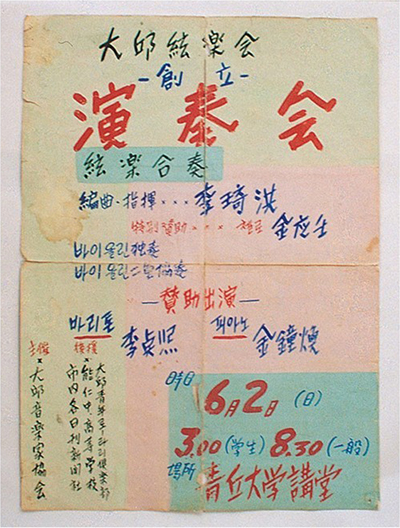
Poster for the Daegu String Society’s inaugural concert, designed by Baek Tae-ho, a painter and teacher/colleague of Lee Ki-hong at Neungin Middle School

Special concert held in the yard of Jongno Elementary School (Apr. 1, 1967)

Pamphlet and newspaper article
(Yeongnam Ilbo, Dec. 19, 1964)
for the DSO’s inaugural concert
(Dec. 17-18, 1964)
1964 to 1980
2. DSO’s founding and formative years
Lee Ki-hong, the DSO’s first principal conductor and the person largely responsible for its founding, held regular concerts based on the traditional “overture-accompanied piece-symphony” structure. He also made a concerted effort to broaden the DSO’s capabilities through special concerts (e.g. Boys’ and Girls’ Concerto Night) and concerts in cities other than Seoul, such as Gyeongju and Pohang. The DSO cemented its reputation as a local orchestra through many celebratory concerts for local events, including the opening of the Gyeongbu Expressway and Daegu Citizens’ Hall. It also featured in a staging of L’elisir d’amore by Keimyung University’s College of Music, La Traviata by Hyosung Women’s University for its 20th anniversary, L’elisir d’amore by the Yeongnam Opera Company (for its 2nd Regular Concert), and La Boheme by the Daegu Opera Company (for its 4th Regular Concert) as part of its efforts to collaborate with local schools and musical groups to broaden the influence of classical music in Daegu.
From 1967, the DSO strived to improve its finesse by performing original works by Daegu-based composers. Through the staging of works by up-and-coming composers such as Moon Mi-hyun and Kang Dong-seok—a bold move at the time—and collaborative performances with traditional Korean musicians, the DSO brought a cornucopia of high-quality concerts to Daegu citizens.

15th Regular Concert held in the auditorium of Hyosung Women’s University for the DSO’s third anniversary (Nov. 24, 1967)

Pamphlet for the 60th Regular Concert, held in celebration of the DSO’s decennial
(Nov. 28, 1974)

Celebratory concert for the opening of Daegu Citizens’ Hall (Oct. 5, 1975)
1981 to 1995
3. DSO’s transition into maturity
Woo Jong-eok, the DSO’s second principal conductor, pursued concerts of diverse genres (e.g. chamber music, gagok (traditional vocal music) and invited many guest conductors in an attempt to broaden the DSO’s scope of activity. The 127th Regular Concert was held as a “collaboration of Korean-Japanese contemporary orchestral music,” indicating the desire of the DSO for capability-building through an active comparison with original music from other countries.
Under the leadership of Kang Su-il, the orchestra’s third principal conductor, the DSO became the second orchestra in Korea to sell tape and LP recordings of pieces by Antonín Dvořák and Johann Strauss II. In May 1990, the Daegu Arts Center opened its doors. It became the DSO’s new home and, as a result, the venue for most of the DSO’s concerts. Park Sung-wan, the fourth principal conductor, concentrated on building up the DSO’s basic performing skills. During Park’s term, the DSO received widespread praise for its efforts to cultivate local musicians (e.g. inviting local musicians to be co-performers) and unconventional concert ideas (e.g. Collaboration by Poetry, Art and Music; collaborative performances with daegeum and gayageum players).

Cassette tape and LP recordings of the DSO
(conducted by Kang Su-il, Dec. 27, 1987)

Pamphlet for the 130th Regular Concert, held in celebration of the DSO’s 20th anniversary
(Dec. 21, 1984)

Pamphlet for the DSO’s 30th anniversary concert (Nov. 29, 1994)
1996 to 2013
4. DSO’s growth
During the DSO’s phase of rapid growth, it was led by a succession of three foreign principal conductors (Ravil Martinov (5th), Boguslaw Madey (6th), and Vakhtang Jordania (7th)), followed by Lee Hyun-se (8th) and Kwak Seung (9th). Throughout the leadership of these foreign conductors, the DSO grew significantly in instrumental skill by making bold changes in stage design and performing pieces by unfamiliar composers. Lee Hyun-se was well-received for his seasonal concert series grounded in ensemble music. Lee also, following in the footsteps of Kang Su-il, produced a CD album of the DSO’s performance of Bartók’s Hungarian Pictures and Elgar’s Enigma Variations.
Kwak, who was renowned for his “solid and balanced music,” brought about a significant improvement in the DSO’s performance skills through his powerful leadership and stringent rehearsals. In 2010, the DSO performed in Osaka and Tokyo to promote the IAAF World Championships to be held in 2011. Its first overseas concert was a resounding success, well-received by Japanese audiences and critics alike. This led to the DSO being invited to Asia Orchestra Week 2011, held in Tokyo, as the Korean representative as well as to perform in the opening concert.

Pamphlet for the 314th Regular Concert in honor of the DSO’s 40th anniversary (Nov. 26, 2004)

Opening performance for Asia Orchestra Week in Japan (Oct. 2, 2011)
2014 to present
5. DSO’s rise
Julian Kobatchev, the DSO’s 10th principal conductor, brought about a classical music sensation through his nine-year term, leading to most concerts being sold out. The 409th Regular Concert was held on the year of the DSO’s 50th anniversary in cooperation with Yoon Su-young, a violinist and former concertmaster. In addition to its domestic successes, the DSO excelled overseas. In 2016, it toured Germany, the Czech Republic, and Austria with resounding success, signaling its readiness to be competitive on the global stage. Kobatchev completed his term by conducting the 492nd Regular Concert on March 24, 2023.
Baek Jin-hyoun began his term as the 11th principal conductor with the 499th Regular Concert, determined to captivate audiences with “fresh ideas and music that transcends era and genre.” The concert showcased pieces by Gustav Mahler and Ottorino Respighi to reflect Baek’s commitment to the DSO’s advancement as well as the harmony within it. Baek continues to strengthen the DSO’s ability to perform a diverse repertoire and satisfy the ever-heightening expectations of classical music enthusiasts through high-quality performances of Bruckner, Mahler, Elgar, and others.


Pamphlet for the 409th Regular Concert, held in celebration of the DSO’s 50th anniversary
(Nov. 28, 2014)

Goldener Saal, Wiener Musikverein, Austria, during the Europe tour
(Oct. 2, 2016)

DSO members participating in the Thanks Challenge during a rehearsal for the 463rd Regular Concert, which was held at the height of the COVID-19 pandemic (Jun. 5, 2020)

492nd Regular Concert, Kobatchev’s last concert as DSO conductor (Mar. 24, 2023)

501st Regular Concert, featuring a program identical to the one for the DSO’s inaugural concert to commemorate Lee Ki-hong
(Dec. 15, 2023)

Citizen Happiness Concert held in the Kolon Open Air Music Hall as part of Powerful Daegu Festival 2024 (May 17, 2024)
Today, armed with six decades’ worth of history and tradition, the DSO is one of Korea’s foremost professional performing groups. It has enriched Daegu’s culture and arts scene, playing a critical role in not only advancing locally-crafted music but also providing solace to citizens in times of adversity. These are outcomes of the DSO’s passion for good music and the encouragement and support shown by its audiences through sold-out concerts.
I hope this short tour of the DSO’s 60-year history brought back memories of beloved concerts and allowed you to learn a few new things about how far the DSO has come. I would also like to use this conclusion to remind DSO members to never forget the sacrifices made by their predecessors and continue to be an orchestra that is the pride of Daegu as well as Korea.
Written bySon Tae-ryong (music philologist)
Photo source(s)Daegu Metropolitan City Records Center, Daegu Metropolitan City (Culture & Arts Records Team), Yeongnam Ilbo, Seoul Arts Center, Son Tae-ryong, Kwon Se-hong

Go to: Sixty Years of
the Daegu Symphony
Orchestra

499th Regular Concert, the first concert conducted by Baek Jin-hyoun
(Nov. 10, 2023)

DSO at Korean Orchestra Festival 2024 (Apr. 9, 2024)